Bayline Pros of Mill Valley brand markBayline ProsSub-Zero · Mill Valley

Symptom · warm fresh-food, warm freezer, triage

Sub-Zero Not Cooling: a Diagnostic Guide for Mill Valley

A “not cooling” call from Corte Madera often starts with the display: a control board, thermistor or display alarm has flagged something, and the unit feels warmer than it should. The alarm is a clue, not a verdict — it reports what a sensor told it, and the useful work is figuring out whether the sensor, the airflow, or something larger is behind it.

The most common pattern is the fresh-food section warming while the freezer still holds. That split is diagnostic gold: it usually rules the compressor out and points at airflow, the evaporator fan, or a defrost fault. What a phone call can’t settle is which of those it is — the temperatures in each compartment, measured on-site, are what separate a fan job from a defrost job.

Quick answer

If both compartments are warm, start by checking power and the condenser; if only the fresh-food side is warm, suspect airflow, the evaporator fan or defrost — not the compressor. We triage with real temperature readings in each compartment before naming a part.

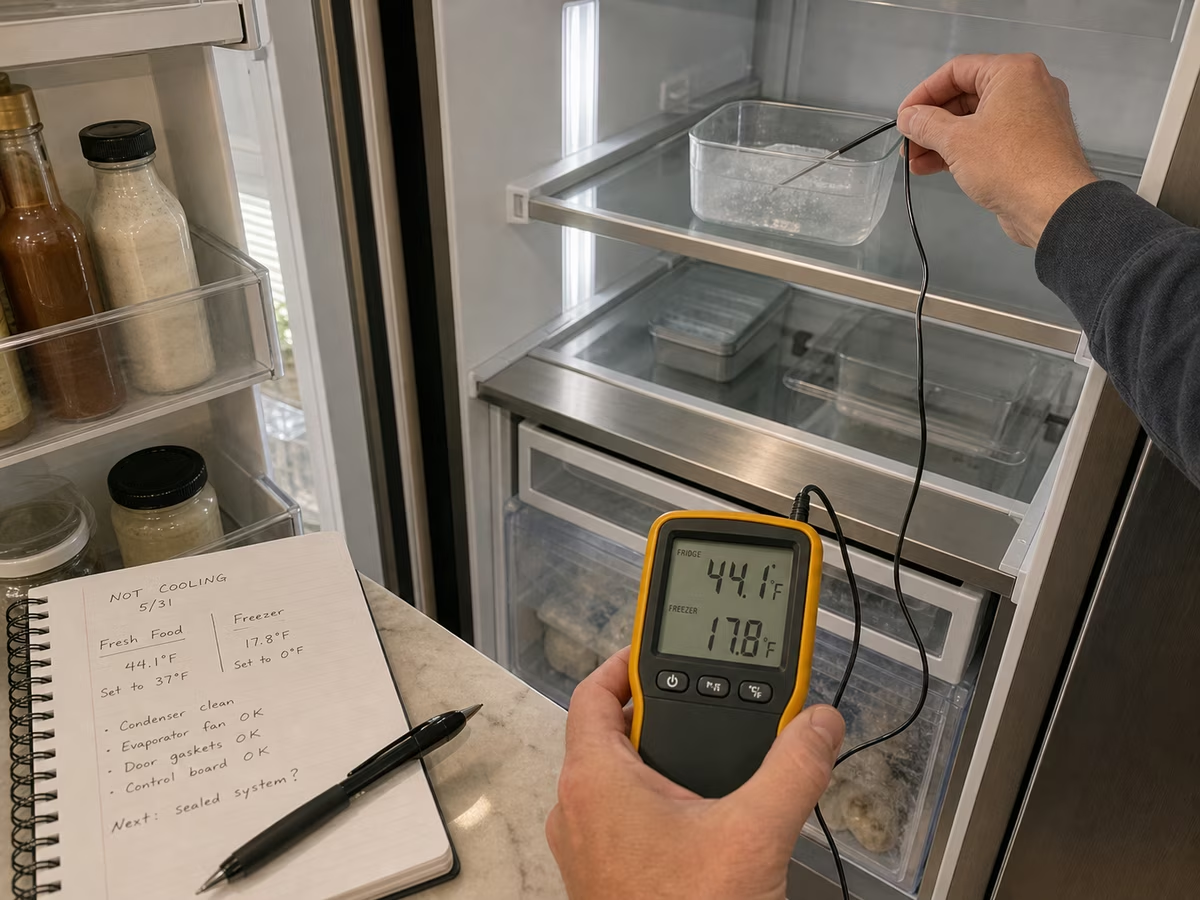
Technician taking compartment temperature readings on a Sub-Zero during a not-cooling diagnosis
SERVICE IMAGETechnician taking compartment temperature readings on a Sub-Zero during a not-cooling diagnosis
sub-zero-not-cooling-readings-millvalley.avif
DIAGNOSISReadings first: fresh-food and freezer temps tell us where the fault is before any part is named.

Diagnostic matrix, before any badges

Read the pattern, then the part

This is the core of the page: match what your unit is doing to the likely cause, simplest first.

Not-cooling triage for Sub-Zero
What you seeLikely causeOn-site testTypical repair
Fresh-food warm, freezer coldEvaporator airflow / fanFan operation + evap tempEvaporator fan, serial-matched
Fresh-food warm, frost on evapDefrost circuitDefrost heater + thermostatDefrost component
Both compartments warmingCondenser airflowCoil inspection + run timeCondenser clean / fan
Constant running, warm driftDirty condenserCoil and fan checkClean and re-verify
Warm + control alarmThermistor / boardRead code by serialSensor or board, verified
No cooling at allPower / start / sealedElectrical + gauge checkDiagnosed before condemning
Ice maker also slowShared airflow / freezeFill + temp checkOften water-side, not sealed

Local proof & evidence

From Larkspur to Belvedere: what a clean diagnosis looks like

In Larkspur’s mix of older and remodeled kitchens, the same “warm fridge” complaint can be three different repairs one street apart, which is exactly why we measure instead of assume. A related tell: when the ice maker has also gone slow, jammed or is producing hollow cubes alongside the warming, it usually points to the water side rather than a deeper cooling failure. Across Belvedere and the bayfront we document every call the same way — temperature readings, condenser/evaporator photos, the model-tag image, and the OEM fan, gasket or control-board evidence once a part is confirmed.

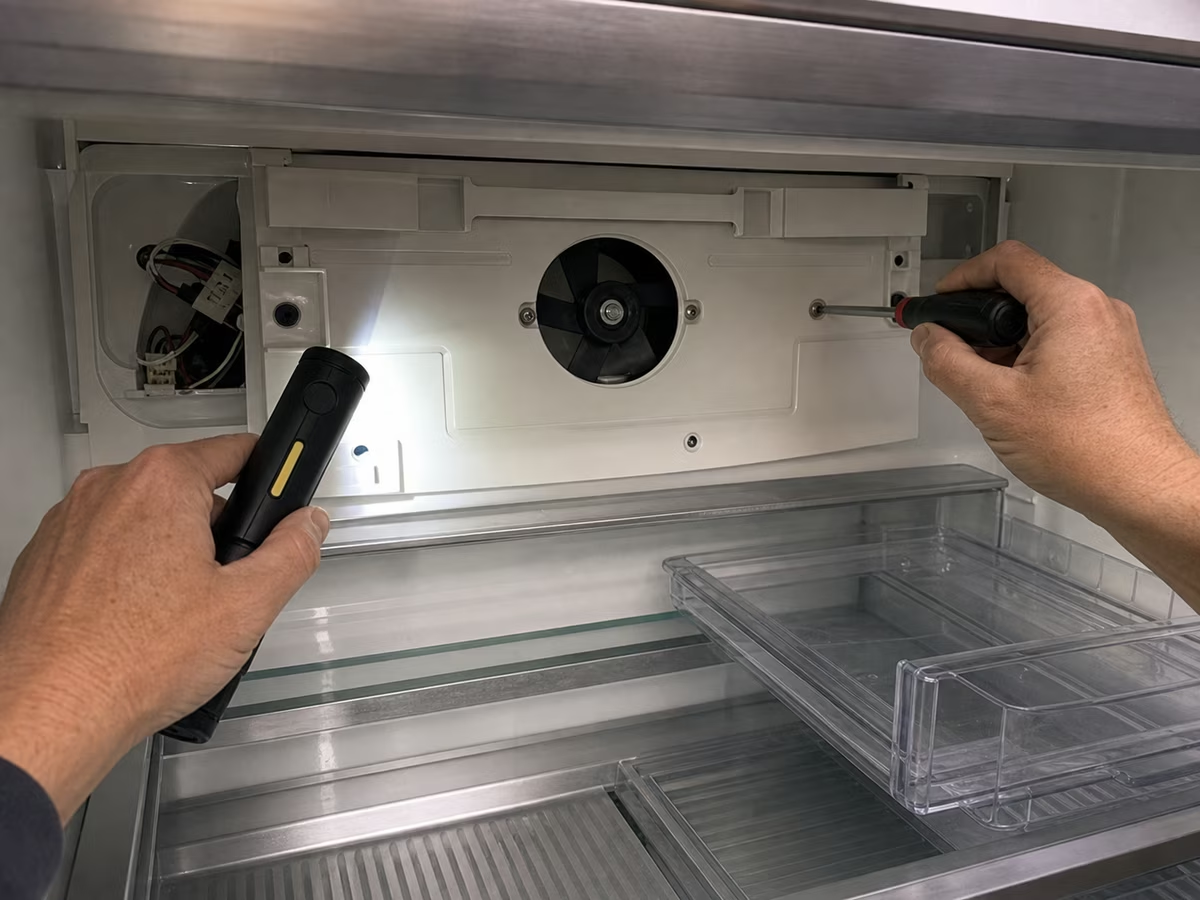
Sub-Zero evaporator fan area inspected during a not-cooling diagnosis
SERVICE IMAGESub-Zero evaporator fan area inspected during a not-cooling diagnosis
sub-zero-evaporator-fan-context.avif
JOBEvaporator fan area: the usual answer when the freezer is fine but the fridge is warm.
Thermometer showing 37 degrees in a repaired Sub-Zero fresh-food compartment
SERVICE IMAGEThermometer showing 37 degrees in a repaired Sub-Zero fresh-food compartment
sub-zero-not-cooling-verify-37f.avif
VERIFYVerification after the fix: 37°F fresh-food, photographed before we leave.

Warm fridge, cold freezer? Let’s check the part first.

Have the model number ready and tell us which compartments are warm. We’ll confirm whether the likely evaporator fan or defrost part is on the van before we book your window.

Mill Valley price ranges

Sub-Zero not-cooling repair price ranges in Mill Valley

Typical Mill Valley ranges for a Sub-Zero that is warm in the fresh-food section while the freezer still holds. The firm price comes after on-site diagnosis.

Sub-Zero not-cooling repair price ranges in Mill Valley
Service / symptomWhat is includedPrice rangeTime on site
Diagnostic visitModel/serial read, fresh-food & freezer temps, airflow and condenser inspection$165–$24545–90 min
Condenser deep-clean & airflow restoreCoil clean, fan check, salt-dust and pet-hair removal$190–$4201–2 hr
Evaporator fan motor (OEM, serial-matched)Diagnosis, OEM fan, post-repair temperature log$385–$7201–2 hr
Defrost heater / thermostat / sensorDefrost-circuit test and component replacement$340–$6801–3 hr
Damper / air-baffle controlAirflow control test and damper replacement$310–$6201–2 hr
Sealed-system / compressor (after gauge proof)EPA-compliant refrigerant diagnosis and repair$1,500–$3,7502–6 hr + parts

What sets the final price: which component the readings confirm, the Sub-Zero line and part variant, cabinet access in panel-ready installs, and whether sealed-system testing is required.

Step by step

How to triage a warm Sub-Zero fresh-food section in Mill Valley

Before booking, these owner-safe checks tell us whether it is airflow, defrost or the sealed system — and what to have ready.

  1. Read the two temperatures. Note the fresh-food and freezer readings. A warm fresh-food side at 45–55°F with a near-0°F freezer usually points to airflow or defrost, not the compressor.
  2. Check the condenser airflow. Pull the lower grille and look for dust, pet hair and coastal salt grime packing the condenser — the most common Mill Valley cause of warm drift.
  3. Listen for the evaporator fan. With the door switch held in, a silent or stuttering evaporator fan often explains a warm fresh-food side while the freezer holds.
  4. Stop opening the door to reset it. Repeatedly opening the door loads the cabinet with humid, foggy air and frosts the evaporator further. Leave it closed and log the readings.
  5. Photograph the model/serial tag. It sits on the upper-left interior wall. Sending it lets us pre-stock the exact fan, defrost part or damper for your line before the visit.

Fast facts

Sub-Zero not-cooling facts for Mill Valley

  • A healthy Sub-Zero holds about 37°F in the fresh-food section and 0°F in the freezer; a fresh-food reading above 42°F with a still-cold freezer points to airflow, the evaporator fan or defrost — not the compressor.
  • Typical Mill Valley range to restore a warm fresh-food section: $190–$720, depending on whether it is a condenser clean, an evaporator fan or a defrost part.
  • Coastal fog and salt air off Richardson Bay corrode condensers faster here, so a warm-drift complaint in Strawberry or Tam Valley often starts with a coil clean before any part is replaced.
  • Sealed-system or compressor work is only quoted after gauge pressures and logged temperatures; in Mill Valley that range runs $1,500–$3,750.

Mill Valley before-you-call checks

Safe checks that preserve evidence

Owner-safe not-cooling checks
CheckWhat to recordWhy it matters
Doors and gasketsAny frost line, condensation or gapHumid air can mimic a cooling failure.
Temperature settingsSet point and displayed readingSeparates setting errors from actual drift.
Lower grilleVisible dust or blocked airflowCondenser restriction is common in tight cabinets.
Recent power eventOutage, breaker trip or resetExplains one-time alarms without replacing parts.
Compartment splitFresh-food and freezer readingsFreezer holding usually lowers compressor suspicion.

Do not force a pull-out, keep cycling power, or scrape away a repeated frost pattern before photos are taken. Those actions can hide the clue that separates a fan, defrost, gasket or sealed-system path.

For the stronger hub version of this page, use the Mill Valley temperature-log guide.

Reviews

What Mill Valley Sub-Zero owners say

★★★★★

“Our Sub-Zero 632 was warm up top — fresh-food climbed to 52°F while the freezer held at 0°F. Tech reached Homestead Valley within a few hours, found a failed evaporator fan and a dust-packed condenser, and brought it back to 37°F the same day. $415 for the fan and coil clean.”

— Hannah W., Homestead Valley 94941
★★★★★

“Freezer fine, fridge side warming after the foggy week. They logged temps before touching anything and it was a defrost heater fault, not the compressor. $360, done in two hours in Strawberry.”

— Andre C., Strawberry 94941
★★★★★

“650-series running constantly and drifting warm in Tam Valley. Salt air had corroded the condenser; a deep clean and airflow restore fixed it for $230 with no parts needed.”

— Owen B., Tam Valley 94941

Not-cooling questions

FAQ

My freezer is fine but the fridge is warm — what is it?

That split usually points to the fresh-food evaporator airflow: a failing evaporator fan or a defrost fault, not the compressor. We confirm with compartment readings before replacing anything.

Should I throw out my food right away?

Check the freezer first — if it is holding, frozen food is safe for now. Move perishables from a warm fresh-food section to a cooler and call; most of these repairs are quick once diagnosed.

Does a control alarm mean the board is bad?

Not necessarily. The board reports what a sensor tells it. A faulty thermistor can trigger an alarm; we read the code against your serial before condemning a board.

Could it be low refrigerant?

Possibly, but it is far down the list for a warm-fresh-food-only complaint. We rule out airflow, fans, defrost and the condenser first, and verify the sealed system with gauges if needed.

What does it cost to fix a warm Sub-Zero in Mill Valley?

Most warm-fresh-food repairs run $190–$720: a condenser/airflow restore at the low end, an OEM evaporator fan or defrost part at the high end. Sealed-system work, only after proof, runs $1,500–$3,750. Diagnosis is $165–$245, credited.

What temperature should my Sub-Zero hold, and when should I worry?

About 37°F in the fresh-food section and 0°F in the freezer. A fresh-food reading above 42°F with a still-cold freezer points to airflow, the evaporator fan or defrost — move perishables and book a window.

Call (415) 683-1487Book online